
Intermittent Fasting vs. Calorie Deficit: Which Works Better (and Why)?
Do you really need to track every single bite, or is the secret to weight management all about when you eat? This is the ultimate question for anyone serious about sustainable health.
For women who want to stop guessing and start leveraging science, understanding the difference between the calorie deficit and Intermittent Fasting (IF) is key. Let’s break down the truth about these two powerhouse methods so you can choose the strategy that truly works for you.

The Fundamental Law: The Calorie Deficit
If your goal is to lose weight, specifically stored body fat, there is one universal law that must be satisfied. This principle underpins every successful weight management plan: the calorie deficit.
What It Is and How It Works
A calorie deficit means consistently consuming fewer calories than your body uses for energy each day.
The Science Simplified: Your body requires a certain amount of energy, your Total Daily Energy Expenditure (TDEE), to fuel all its functions, even at rest.
To lose weight, you simply need your Calories In (from food and drink) to be less than your Calories Out (your TDEE). When you consume less than your TDEE, your body is forced to tap into its stored energy, your fat reserves, to cover the difference
Read more: Calorie counting made easy

💡 Quick Tip:
Extreme calorie cutting is often counterproductive. For those who focus on long-term health, a moderate, sustainable deficit is key. Aim for an approach you can stick to, ensuring you get all your essential nutrients without constant hunger.
Intermittent Fasting (IF) Decoded: Timing is Everything
Intermittent Fasting (IF) is less of a diet and more of a structured eating pattern. It’s a strategic tool that organises when you eat, rather than focusing purely on what you eat.
Understanding the IF Methods
IF involves cycling between voluntary periods of eating and fasting. The most popular methods are time-restricted eating, such as:
16:8 method: Fasting for 16 hours and eating during an 8-hour window.
14:10 method: Fasting for 14 hours and eating during a 10-hour window, often preferred as a gentler starting point for women.
You can learn more about these methods here.

The Metabolic Magic of Fasting
When you fast for an extended period, you basically tell your body: “The food kitchen is closed. Time to find fuel in storage.”
Lowering Insulin: Fasting dramatically lowers the hormone insulin. When insulin is low, your body easily shifts into 'fat-burning mode,' accessing stored fat for fuel.
Training Your Engine: Fasting forces your body to switch its primary fuel source from glucose, sugar, to stored fat. This essential skill is called metabolic flexibility, the secret behind people who stay lean.
Beyond fat burning, fasting triggers autophagy, cellular clean-up. This powerful process helps your cells clear out old, damaged components, boosting your overall cellular efficiency.
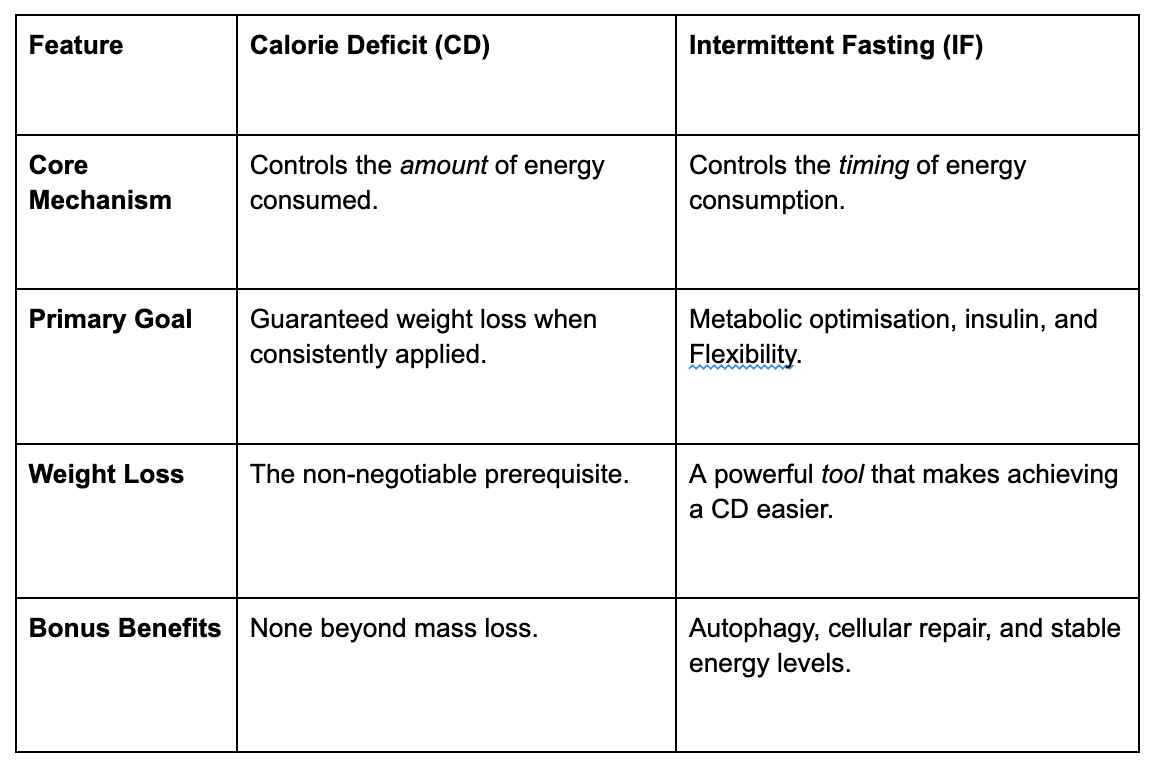
Comparing the Approaches: Tools for Weight Management
The Most Powerful Strategy: Combining the Best of Both Worlds
Which one is better? The truth is, the most powerful and sustainable strategy for us is often both.
For those serious about long-term health, the best strategy is to achieve a moderate calorie deficit within a restricted eating window like a 14:10 or 16:8 schedule.
By combining the two, you get the absolute guarantee of the deficit while activating all the deep, powerful metabolic upgrades that IF offers. You ensure that when you are eating, you’re providing your body with the nutrients it needs, and when you’re fasting, you’re teaching it to be a more efficient fat-burning machine.
If counting calories feels too complicated, start with IF. It’s often the easiest way to reduce total intake without tedious measuring naturally.

Sustainable Wellness Unlocked
Weight management is not about quick fixes, it’s about creating a lifestyle where your body works for you. By mastering the fundamental law of the calorie deficit and leveraging the strategic timing of Intermittent Fasting, you are not just shedding weight, you are building a resilient, flexible, and efficient metabolic engine. That is the true secret to long-lasting health.